Mineral SPF & Sun Protection
SPF 30 vs SPF 50 for sensitive skin
One percentage point of UVB, and a much bigger difference in whether you actually wear it.
By Michael W. · Last updated
The short answer
SPF 50 if you will wear it properly, SPF 30 if the SPF 50 you own is too thick to use every day - because the sunscreen you apply beats the one you skip. The measured difference is small: SPF 30 filters about 97% of UVB and SPF 50 about 98%. With rosacea the case for 50 is still real, because it leaves more margin when you inevitably underapply, and UV is the most frequently reported trigger in the National Rosacea Society patient surveys. La Roche-Posay Anthelios Mineral SPF 50 is the SPF 50 worth wearing daily; Vanicream Facial Moisturizer SPF 30 is the SPF 30 that wins on everything except the number.
Some links on this page are affiliate links. If you buy through one, we may earn a commission at no extra cost to you - it is what funds the site. It does not change what gets recommended or in what order. Full disclosure.
The honest headline is that the difference between SPF 30 and SPF 50 is smaller than the numbers suggest, and it is not a question of 30 versus 50 percent of anything. SPF is a ratio of how long it takes skin to redden with the product on versus without it, measured under laboratory conditions at an application density of two milligrams per square centimetre. Converted into the share of UVB blocked, SPF 30 is roughly 97% and SPF 50 is roughly 98%.
One percentage point sounds negligible, and in terms of UVB reaching the skin it is a third less - 3% through versus 2% through. Both framings are true, which is why the argument goes round in circles. The useful way to settle it for reactive skin is to ignore the headline number and ask three questions instead: how much are you actually applying, how often are you reapplying, and which bottle will you still be using in three months.
What the numbers actually mean
| SPF | UVB blocked (at full lab dose) | UVB reaching skin | At a realistic half dose |
|---|---|---|---|
| 15 | About 93% | 7% | Closer to SPF 4 |
| 30 | About 97% | 3% | Closer to SPF 5 to 6 |
| 50 | About 98% | 2% | Closer to SPF 7 |
| 70 | About 98.6% | 1.4% | Marginal gain over 50 |
| 100 | About 99% | 1% | Diminishing to the point of irrelevance |
The fourth column is the one that matters and the one nobody prints on a bottle. SPF protection does not scale linearly with how much you apply - it falls off faster than the dose does - so applying half the tested amount of an SPF 50 leaves you with far less than SPF 25. Since most people apply between a quarter and a half of the lab dose, the real-world gap between a 30 and a 50 is wider than the lab gap, and that is the strongest argument for buying the higher number.
Why SPF is not the only number on the bottle
- SPF measures UVB only. It is a sunburn number. UVA, which penetrates deeper and contributes to photoageing and to vessel damage, is not in it.
- Broad spectrum is the UVA claim in the US, and it is a pass-or-fail test rather than a scale. A broad-spectrum SPF 30 can offer better UVA protection than a non-broad-spectrum SPF 50.
- Mineral filters cover UVA differently. Zinc oxide gives better long-UVA coverage than titanium dioxide, which is one reason zinc-led formulas are preferred here.
- Water resistance is tested at 40 or 80 minutes and is not a function of SPF. A high SPF that slides off is not protecting anything.
- Visible light is not covered by SPF at all. Iron oxide tints are the only common cosmetic ingredient that filters it, which matters for redness - see does tinted sunscreen help rosacea.
For rosacea specifically, the second and fifth points carry more weight than the SPF number does. Broad spectrum is non-negotiable, and a tint is a genuine upgrade rather than a cosmetic one. Given a choice between a broad-spectrum tinted mineral SPF 30 and an untinted SPF 50, we would take the 30 - which is the one place on this site where we would actively recommend the lower number.
The screen
Every product on this page had to clear all of the following before it was considered on its merits. This is the exclusion step, and it runs before any recommendation.
- No added fragrance or parfum anywhere in the ingredient list.
- No essential oils, including ones declared under a botanical name.
- No denatured alcohol, witch hazel, menthol, camphor or peppermint.
- No physical scrub particles.
- Sold in the US right now, from a brand that publishes its full ingredient list.
- Every remaining flagged ingredient is named on the product card rather than quietly left out.
Ingredient lists last checked 2026-09-29. Formulas change - if you spot a discrepancy, the published list on the brand's own site wins and we want to know.
Quick picks
Every product here cleared the screen. Tap a row for the full write-up.
| # | Product | Best for | Fragrance | Price |
|---|---|---|---|---|
| 1 | 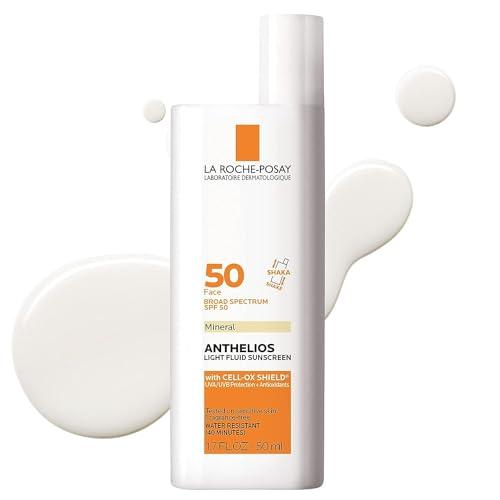 La Roche-Posay Anthelios Mineral Zinc Oxide Sunscreen SPF 50 Mineral-only filters at SPF 50, fragrance-free, in a fluid base that actually spreads instead of dragging. | Mineral-only SPF 50 that still spreads | Free | |
| 2 | 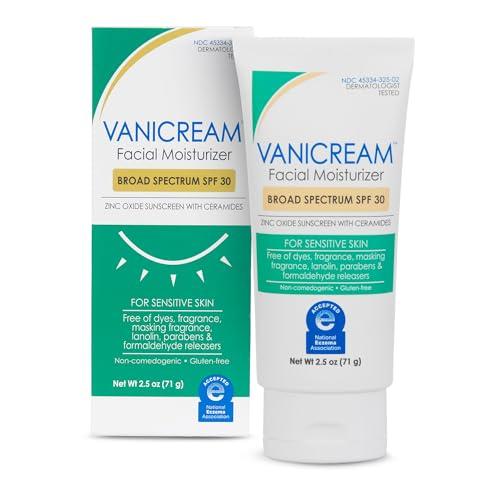 Vanicream Facial Moisturizer SPF 30 Zinc oxide at 19.5% - the highest single-filter load here - with five ceramides and squalane in the base. | Zinc-only SPF with a moisturizer built in | Free | |
| 3 | 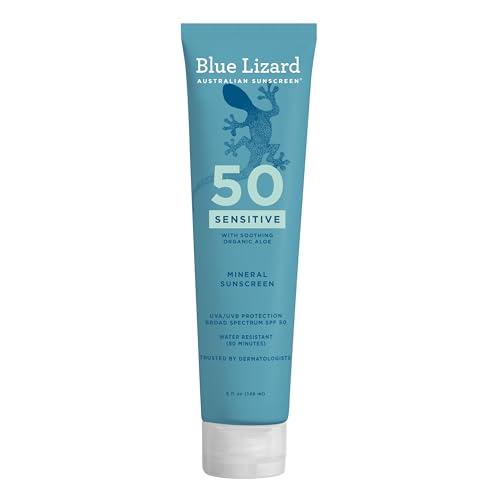 Blue Lizard Sensitive Mineral Sunscreen SPF 50+ Mineral-only at SPF 50+, fragrance-free and paraben-free, in a water-resistant base. | High-SPF mineral for long days outside | Free |
#ad - Amazon links are affiliate links. Prices come from the Amazon API, are refreshed daily, and disappear rather than go stale - the button shows the current number or it asks you to check.
The picks, in order
1. Mineral-only SPF 50 that still spreads
La Roche-Posay Anthelios Mineral Zinc Oxide Sunscreen SPF 50
Product photo from Amazon.
Mineral-only filters at SPF 50, fragrance-free, in a fluid base that actually spreads instead of dragging. The trade is a visible cast on deeper skin tones, which the tinted version solves.
Filters: Titanium dioxide 6%, zinc oxide 5%
What is in it
- Titanium dioxide 6%
- Zinc oxide 5%
- Dimethicone
Best for
Mineral-only SPF 50 that still spreads
Strengths
- 100% mineral - titanium dioxide 6% and zinc oxide 5%, no chemical filters
- SPF 50 with a genuinely light fluid texture
- No added fragrance
- Layers under makeup without pilling
Trade-offs
- Leaves a white cast on medium and deep skin tones
- The fluid finish is matte - dry skin needs moisturizer under it
Who should skip it: If a white cast is a dealbreaker, go straight to a tinted mineral formula - untinted zinc always casts.
#ad How we are funded - price as of November 18, 2026
Ingredient list read at INCIDecoder - La Roche-Posay Anthelios Mineral Zinc Oxide Sunscreen SPF 50.
2. Zinc-only SPF with a moisturizer built in
Vanicream Facial Moisturizer SPF 30
Product photo from Amazon.
Zinc oxide at 19.5% - the highest single-filter load here - with five ceramides and squalane in the base. It is a moisturizer and a sunscreen in one step, which is exactly what a short routine needs.
Filters: Zinc oxide 19.5%
What is in it
- Zinc oxide 19.5%
- Ceramides EOP, NG, NP, AS and AP
- Squalane
- Glycerin
Best for
Zinc-only SPF with a moisturizer built in
Strengths
- Zinc oxide only at 19.5% - no titanium dioxide, no chemical filters
- Five ceramides plus squalane, so it moisturizes properly
- No fragrance, masking fragrance, lanolin, parabens or formaldehyde releasers
- Collapses two steps into one
Trade-offs
- SPF 30, not 50 - you need to reapply more attentively
- A high zinc load means a real white cast
Who should skip it: If you are outdoors for hours or want SPF 50, step up to a dedicated high-SPF mineral formula.
#ad How we are funded - price as of November 18, 2026
Ingredient list read at Vanicream - Mineral Facial Moisturizer with SPF 30.
3. High-SPF mineral for long days outside
Blue Lizard Sensitive Mineral Sunscreen SPF 50+
Product photo from Amazon.
Mineral-only at SPF 50+, fragrance-free and paraben-free, in a water-resistant base. It is the one to take on a hike rather than the one to wear under makeup.
Filters: Zinc oxide 10%, titanium dioxide 8%
What is in it
- Zinc oxide 10%
- Titanium dioxide 8%
- Tocopheryl acetate
Best for
High-SPF mineral for long days outside
Strengths
- Mineral only - zinc oxide 10% and titanium dioxide 8%
- SPF 50+ with water resistance
- No fragrance, no parabens, no chemical filters
- Large bottle - practical for face and body
Trade-offs
- Thick and noticeably casting
- Contains beeswax, so it is not vegan
Who should skip it: Not the pick for daily wear under makeup - it is too heavy. Use a fluid mineral for that.
#ad How we are funded - price as of November 18, 2026
Ingredient list read at INCIDecoder - Blue Lizard Sensitive Mineral Sunscreen SPF 50+.
When to choose which
- 1Daily indoor-to-commute use, and you want one step. SPF 30 is sufficient - Vanicream Facial Moisturizer SPF 30, which is a moisturizer and a zinc-only sunscreen in one.
- 2Daily use plus any outdoor time. SPF 50 - La Roche-Posay Anthelios Mineral SPF 50, the mineral fluid that spreads without dragging.
- 3A full day outside, or anything near water or snow. SPF 50+ with water resistance - Blue Lizard Sensitive SPF 50+, and reapply every two hours regardless.
- 4You are mid-flare and everything stings. The gentlest formula you tolerate, at whatever SPF it comes in, plus a hat. A sunscreen you cannot bear to apply protects nothing.
- 5You are using azelaic acid, a retinoid or an acid. SPF 50, because photosensitivity is higher - the retinol introduction method is at how to start retinol with sensitive skin.
The fourth case is worth dwelling on because it inverts the usual advice. During an active flare, the correct move is often to simplify rather than optimise: shade, a wide-brimmed hat, sunglasses and the least irritating product you own. Physical avoidance is free, has no ingredient list and is the only form of sun protection that cannot sting. The flare protocol is at how to calm a rosacea flare up.
How much to apply, and how often
The lab dose of two milligrams per square centimetre works out to roughly a quarter of a teaspoon for a face, or the often-quoted two-finger rule - a line of product down the length of your index and middle fingers. Most people apply far less than that, which is the real reason sunscreens underperform in daily life, and it is also why the SPF 30 versus 50 debate is academic next to the question of quantity. The detailed version is at how much sunscreen to use on your face.
Reapplication is the other half. No sunscreen at any SPF survives two hours of outdoor exposure, sweat or towel contact, and a higher number does not extend the interval - it raises the ceiling, not the duration. For a day indoors, one morning application is realistically enough for most people. For anything outdoors, two hours is the interval, and if that is impractical then shade and clothing have to do the work instead.
How we chose
SPF values and filter percentages are read off each product's drug facts panel, and the UVB transmission figures are the standard mathematical conversion from SPF - not a measurement we performed. Ingredient lists read on each brand's own site and on INCIDecoder, with the source linked on every pick, screened for added fragrance, masking fragrance, essential oils and the flagged ingredients on our avoid list. Prices are pulled from the Amazon API, refreshed daily and stamped with the date they were read. Method at how we choose.
Questions people ask
Is SPF 50 better than SPF 30 for sensitive skin?
Slightly, on paper - about 98% of UVB blocked against 97%. The real advantage is margin: because almost everyone underapplies, a 50 leaves more protection in reserve than a 30 does. But the sunscreen you wear daily beats the higher number you avoid because it feels unpleasant.
Is SPF 30 enough with rosacea?
Yes for ordinary daily use, provided it is broad spectrum and you apply enough. Step up to SPF 50 for outdoor time, and prefer a tinted mineral formula if visible redness is your main concern - iron oxide tints filter visible light, which SPF does not measure at all.
Why is the difference between SPF 30 and 50 so small?
Because SPF is a ratio on a curve that flattens. Going from no protection to SPF 15 removes most of the UVB; everything above that is chasing the last few percent. SPF 100 still lets about 1% through.
Does a higher SPF last longer?
No. SPF raises the level of protection, not its duration. Every sunscreen needs reapplying roughly every two hours outdoors regardless of the number on the bottle.
How much sunscreen should I use on my face?
About a quarter of a teaspoon, or the two-finger rule - a line of product along your index and middle fingers. Applying half the tested amount costs you far more than half the protection.