Ingredients & Triggers
Is glycerin good for rosacea?
The cheapest ingredient in your routine is also the one with the least to argue about.
By Michael W. · Last updated
The short answer
Yes, without caveats worth worrying about. Glycerin is a small humectant that pulls water into the stratum corneum, and it is one of the few ingredients with genuine barrier-repair evidence behind it rather than just moisturizing claims. Contact allergy is vanishingly rare and it does not clog pores. The one condition: a humectant needs something above it to hold the water in, so glycerin works best under or alongside an occlusive. Vanicream Gentle Facial Cleanser leads on it, CeraVe Moisturizing Cream pairs it with ceramides and petrolatum, and Avene Tolerance Control is the fifteen-ingredient version.
Some links on this page are affiliate links. If you buy through one, we may earn a commission at no extra cost to you - it is what funds the site. It does not change what gets recommended or in what order. Full disclosure.
Almost every ingredient page on this site ends in a qualification. Niacinamide helps most people and flushes a minority. Centella has the best evidence of the soothing botanicals and most products underdose it. Shea butter is fine on your legs and questionable on your nose. Glycerin is the rare case where the answer is simply yes, and the interesting part is not whether to use it but how it actually works - because getting that wrong is the one way to make a glycerin product disappoint you.
Glycerin is a three-carbon molecule with three hydroxyl groups, which is a technical way of saying it is very small and very thirsty. Applied to skin it draws water into the upper layers, both from the air and from deeper in the tissue. It also has published evidence for improving barrier recovery and for maintaining the stratum corneum in a more flexible state - which is why it appears in the first five ingredients of a large share of the products this site recommends, including almost every pick on every page.
What glycerin does, and the one thing it needs
| Property | The detail | What it means for you |
|---|---|---|
| Humectant | Draws water into the stratum corneum from air and deeper tissue | The hydration step, not the sealing step |
| Barrier recovery | Published support for faster recovery after barrier disruption | Useful during and after a flare |
| Contact allergy | Extremely rare in patch-test series | One of the safest ingredients in cosmetics |
| Comedogenicity | Non-comedogenic | No central-face caution |
| Needs an occlusive over it | Water drawn in will leave again in dry air without one | Pair it, do not rely on it alone |
| Behaviour in very dry air | At high concentrations on its own it can draw water from skin outward | Why pure glycerin is a bad face product |
| Stickiness | Noticeable above roughly 10% in a thin formula | A texture issue, not a safety one |
Rows five and six together explain the only real failure mode. A humectant moves water; it does not keep it. In a cold, dry winter room, a high-glycerin serum with nothing over it can leave skin feeling tighter than before, because the water it pulled to the surface evaporated and took some with it. That is not an argument against glycerin - it is an argument for the two-step pairing that every well-formulated moisturizer already does internally.
How to use it properly, in three steps
- 1Apply to damp skin. Within a minute of cleansing, while there is still water at the surface for the glycerin to work with. This single habit does more than switching products.
- 2Follow with something occlusive. A ceramide cream, a petrolatum-led cream or a mineral sunscreen - anything that slows evaporation. CeraVe Moisturizing Cream does both jobs in one product.
- 3Reapply rather than layering more. Twice daily beats a thicker single application, especially in winter with indoor heating running.
That first step is the most commonly skipped instruction in all of skincare and the cheapest improvement available. The damp-skin rule applies to every humectant, including hyaluronic acid, where the same mechanism and the same caveat apply - the detail on that one is at can you use hyaluronic acid with rosacea.
The screen
Every product on this page had to clear all of the following before it was considered on its merits. This is the exclusion step, and it runs before any recommendation.
- No added fragrance or parfum anywhere in the ingredient list.
- No essential oils, including ones declared under a botanical name.
- No denatured alcohol, witch hazel, menthol, camphor or peppermint.
- No physical scrub particles.
- Sold in the US right now, from a brand that publishes its full ingredient list.
- Every remaining flagged ingredient is named on the product card rather than quietly left out.
Ingredient lists last checked 2026-09-29. Formulas change - if you spot a discrepancy, the published list on the brand's own site wins and we want to know.
Quick picks
Every product here cleared the screen. Tap a row for the full write-up.
| # | Product | Best for | Fragrance | Price |
|---|---|---|---|---|
| 1 | 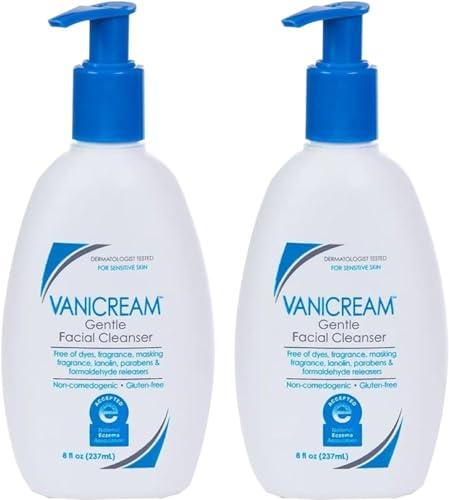 Vanicream Gentle Facial Cleanser Twelve ingredients, no fragrance, no essential oils, no botanical extracts. | The shortest ingredient list on the shelf | Free | |
| 2 | 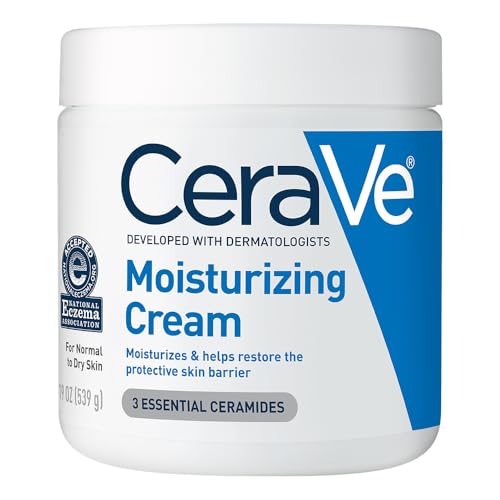 CeraVe Moisturizing Cream Three ceramides plus cholesterol and petrolatum, no fragrance, in a tub big enough to use on your body too. | Barrier repair on a budget | Free | |
| 3 | 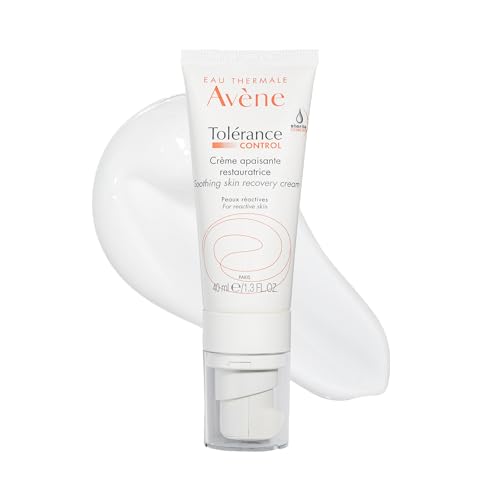 Avene Tolerance Control Soothing Skin Recovery Cream Fifteen ingredients, no fragrance, and no preservative in the ingredient declaration - it ships in a sterile pump instead. | Skin that reacts to almost everything, including preservatives | Free |
#ad - Amazon links are affiliate links. Prices come from the Amazon API, are refreshed daily, and disappear rather than go stale - the button shows the current number or it asks you to check.
The picks, in order
1. The shortest ingredient list on the shelf
Vanicream Gentle Facial Cleanser
Product photo from Amazon.
Twelve ingredients, no fragrance, no essential oils, no botanical extracts. When skin is reacting and you cannot work out to what, this is the cleanser that removes the most variables at once.
What is in it
- Glycerin
- Coco-Glucoside
- Sodium Cocoyl Glycinate
Best for
The shortest ingredient list on the shelf
Strengths
- Twelve ingredients total - the shortest list of any cleanser here
- No fragrance, masking fragrance, essential oils or botanical extracts
- Non-foaming, gentle surfactants (coco-glucoside, sodium cocoyl glycinate)
- Widely stocked and inexpensive for the size
Trade-offs
- Does very little beyond cleaning - no ceramides, no soothing actives
- The lotion texture feels slippery to people used to a foaming wash
Who should skip it: If you wear heavy sunscreen or makeup and want one-step removal, this will not cut through it - double-cleanse or pick a balm.
#ad How we are funded - price as of November 18, 2026
Ingredient list read at INCIDecoder - Vanicream Gentle Facial Cleanser.
2. Barrier repair on a budget
CeraVe Moisturizing Cream
Product photo from Amazon.
Three ceramides plus cholesterol and petrolatum, no fragrance, in a tub big enough to use on your body too. This is the cream most dermatology offices hand out, and the formula earns it.
What is in it
- Ceramide NP, AP and EOP
- Petrolatum
- Sodium Hyaluronate
- Cholesterol
Best for
Barrier repair on a budget
Strengths
- Ceramides NP, AP and EOP with cholesterol - a complete lipid set
- Petrolatum for occlusion plus hyaluronic acid for water
- No added fragrance
- Very low cost per ounce in the large tub
Trade-offs
- Thick - it needs warming between your palms in winter
- The tub invites fingers into the product; the pump version is more hygienic
Who should skip it: Oily or acne-prone skin may find the richness too much for daytime; use the lotion version instead.
#ad How we are funded - price as of November 18, 2026
Ingredient list read at INCIDecoder - CeraVe Moisturizing Cream.
3. Skin that reacts to almost everything, including preservatives
Avene Tolerance Control Soothing Skin Recovery Cream
Product photo from Amazon.
Fifteen ingredients, no fragrance, and no preservative in the ingredient declaration - it ships in a sterile pump instead. If you have reacted to preserved products, this is the one to try.
What is in it
- Avene thermal spring water
- Squalane
- Aquaphilus dolomiae extract filtrate
- Glycerin
Best for
Skin that reacts to almost everything, including preservatives
Strengths
- No preservative listed - sterile packaging does that job
- Fifteen ingredients, no fragrance, no essential oils
- Squalane and glycerin for comfort without heaviness
- The shortest list of any cream here after Vanicream
Trade-offs
- The most expensive per ounce of any pick on this page
- The sterile pump means you cannot scrape out the last of it
Who should skip it: If cost matters more than ingredient minimalism, the CeraVe or Vanicream creams do the barrier job for a fraction of the price.
#ad How we are funded - price as of November 18, 2026
Ingredient list read at INCIDecoder - Avene Tolerance Control Soothing Skin Recovery Cream.
Glycerin on a label, and what sits near it
- Glycerin. The ingredient itself. In the first five, it is doing real work; at the end of a long list, it is a trace.
- Glycerin plus petrolatum or dimethicone. The classic humectant-plus-occlusive pairing. This is a well-built moisturizer.
- Glycerin plus ceramides. Water plus lipids - the combination with the most barrier-repair support behind it.
- Propylene glycol and butylene glycol. Related humectants and solvents. Propylene glycol has a modest contact-allergy record; glycerin does not.
- Sorbitol. Another sugar alcohol humectant, in Vanicream's creams alongside petrolatum.
- Rose water and glycerin blends. Glycerin is fine; the rose component is a fragrance source and a reason to be careful.
The last item is the only place this page needs a warning. Glycerin is often sold to people with rosacea inside DIY-adjacent blends - rose water and glycerin, witch hazel and glycerin, aloe and glycerin - and in every case the glycerin is the harmless part. Rose water is a fragrance ingredient, and witch hazel is on our avoid list for the reasons set out at is witch hazel good for rosacea.
If you are building a routine from scratch, glycerin is not something you shop for separately. Every cleanser, moisturizer and sunscreen on this site contains it already, which is the practical upshot of this page: you do not need a glycerin product, you need to apply the ones you have to damp skin and put something over them. The stripped-back starting routine is at beginner rosacea routine, and how to read the order of ingredients on any label is at how to read a skincare label.
How we chose
Published ingredient lists read on each brand's own site and on INCIDecoder, with the source linked on every pick, screened for added fragrance, masking fragrance, essential oils and the flagged ingredients on our avoid list. Statements about glycerin's humectancy, barrier-recovery evidence and allergy rate reflect the published cosmetic-science position, and we distinguish throughout between what glycerin does and what the formula around it does. Prices are pulled from the Amazon API, refreshed daily and stamped with the date they were read. Method at how we choose.
Questions people ask
Is glycerin good for rosacea?
Yes. It is a humectant with published barrier-recovery evidence, an extremely low allergy rate and no comedogenicity concern. The only condition is that it needs an occlusive over it to hold the water it draws in.
Can glycerin dry out your skin?
In one specific situation: a high concentration applied alone in very dry air, with nothing over it. The water it pulls to the surface evaporates and takes some with it. In a formulated moisturizer, with emollients around it, this does not happen.
Should I put pure glycerin on my face?
No. Neat glycerin is around 99% and intensely hygroscopic. In products it sits at roughly 2 to 10% with occlusives and emollients around it, which is what makes it work.
Is glycerin or hyaluronic acid better for rosacea?
They do the same job by the same mechanism, and glycerin is the smaller molecule with the longer evidence record and the lower price. Neither works well without something occlusive over it, and most good moisturizers contain both.
Is rose water and glycerin good for rosacea?
The glycerin is harmless; the rose water is a fragrance ingredient, which is the part to be cautious about. A plain fragrance-free moisturizer gives you the same glycerin benefit with none of the risk.