Mineral SPF & Sun Protection
Best sunscreens for sensitive skin
The filter panel decides whether it stings. The finish decides whether you keep wearing it.
By Michael W. · Last updated
The short answer
La Roche-Posay Anthelios Mineral Zinc Oxide SPF 50 is the best sunscreen for sensitive skin for most people: mineral-only filters, no added fragrance, and a fluid texture that spreads instead of dragging. If the reason you stop wearing sunscreen is how it looks rather than how it feels, EltaMD UV Clear SPF 46 has the best finish here - but it is a hybrid with octinoxate in it and it contains niacinamide, and this page says so rather than filing it under mineral.
Some links on this page are affiliate links. If you buy through one, we may earn a commission at no extra cost to you - it is what funds the site. It does not change what gets recommended or in what order. Full disclosure.
Sunscreen is the product sensitive skin complains about most, and the reasons are structural rather than mysterious. It is a leave-on. It goes on in more volume than anything else in the routine - a proper face dose is roughly a quarter-teaspoon, which is several times what most people use for a moisturizer. It gets reapplied. And unlike every other product you own, the thing doing the work is a declared active drug ingredient, not a cosmetic one.
So when someone says a sunscreen stung, there are four plausible culprits and only one of them is the filter. The other three are the fragrance, the solvent and - for a minority - niacinamide, which turns up in several of the sunscreens this category is best known for. Sorting out which one applies to you is most of the work, and it is cheaper than buying a seventh bottle. If budget is the binding constraint rather than sensitivity, the price-capped version of this shortlist is at best sunscreens for sensitive skin under $20.
Every sunscreen below was checked against its published Active Ingredients panel and its full inactive list before it was judged on anything else. The ranking is not a list of the strongest sunscreens - at SPF 30 and above, applied properly, they all work. It is a ranking of how few things each one asks your skin to tolerate, against how likely you are to actually wear it.
The screen
Every product on this page had to clear all of the following before it was considered on its merits. This is the exclusion step, and it runs before any recommendation.
- No added fragrance or parfum anywhere in the ingredient list.
- No essential oils, including ones declared under a botanical name.
- No denatured alcohol, witch hazel, menthol, camphor or peppermint.
- No physical scrub particles.
- Sold in the US right now, from a brand that publishes its full ingredient list.
- Every remaining flagged ingredient is named on the product card rather than quietly left out.
Ingredient lists last checked 2026-09-29. Formulas change - if you spot a discrepancy, the published list on the brand's own site wins and we want to know.
Quick picks
Every product here cleared the screen. Tap a row for the full write-up.
| # | Product | Best for | Fragrance | Price |
|---|---|---|---|---|
| 1 | 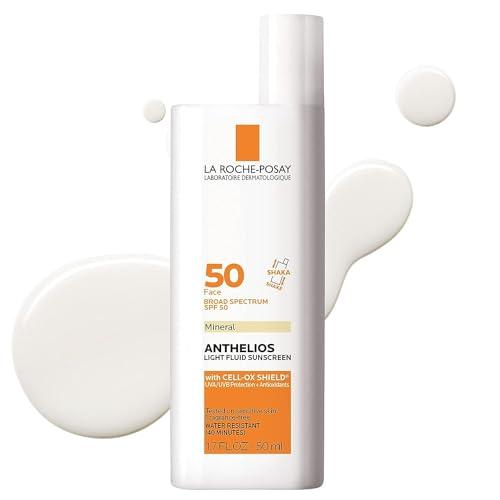 La Roche-Posay Anthelios Mineral Zinc Oxide Sunscreen SPF 50 Mineral-only filters at SPF 50, fragrance-free, in a fluid base that actually spreads instead of dragging. | Mineral-only SPF 50 that still spreads | Free | |
| 2 | 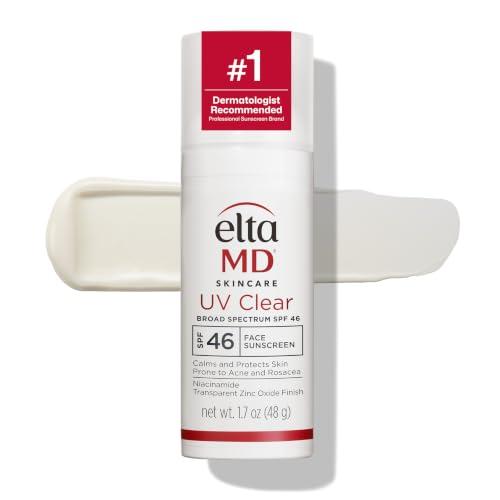 EltaMD UV Clear Broad-Spectrum SPF 46 The most recommended sunscreen in this category, and two facts get left out of most recommendations: it is not mineral-only - it contains octinoxate - and it contains niacinamide. | A weightless finish, if the two caveats do not apply to you | Free | |
| 3 | 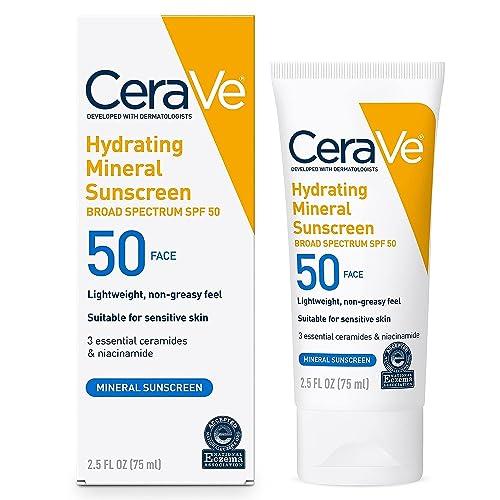 CeraVe Hydrating Mineral Sunscreen Face Lotion SPF 50 Mineral-only filters at SPF 50 with three ceramides and niacinamide in the base, from the cheapest range on this page. | A drugstore mineral SPF with ceramides in the base | Free | |
| 4 | 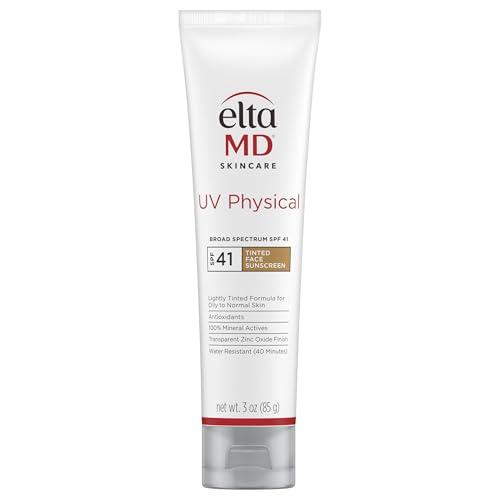 EltaMD UV Physical Broad-Spectrum SPF 41 Mineral-only and tinted with iron oxide, so the cast problem largely disappears. | Tinted mineral SPF with no niacinamide | Free | |
| 5 | 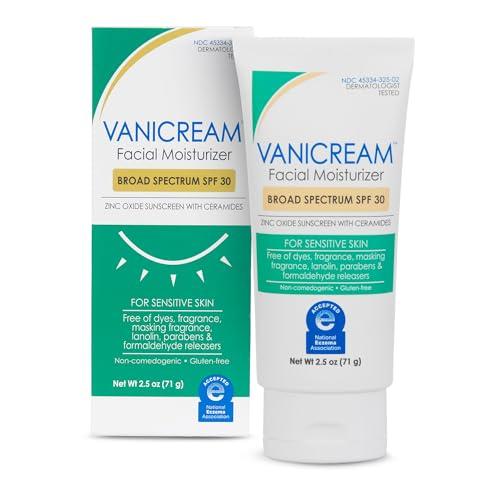 Vanicream Facial Moisturizer SPF 30 Zinc oxide at 19.5% - the highest single-filter load here - with five ceramides and squalane in the base. | Zinc-only SPF with a moisturizer built in | Free |
#ad - Amazon links are affiliate links. Prices come from the Amazon API, are refreshed daily, and disappear rather than go stale - the button shows the current number or it asks you to check.
Mineral or hybrid: the question this page will not dodge
Most sensitive-skin sunscreen lists quietly assume the answer is mineral and then rank five mineral sunscreens. That is a defensible shortcut and it leaves out the single most-recommended product in the category, so here is the actual argument.
Mineral filters - zinc oxide and titanium dioxide - sit in a film on the surface and scatter or absorb UV from there. They are the two filters the FDA has proposed as generally recognized as safe and effective, they have essentially no sensitization record, and they are the filters most often recommended for reactive and rosacea-prone skin. The National Rosacea Society's skin-care guidance points people toward physical blockers for exactly this reason. The cost is cosmetic: a real white cast at the filter loads needed for SPF 50, and a thicker feel.
Organic filters - the ones usually called chemical - absorb UV within the film and convert it. They are far more cosmetically elegant and that is not a trivial advantage, because a sunscreen you skip has an SPF of 1. The honest caveats are that a small number of people do develop contact or photocontact allergy to specific organic filters, and that the FDA's 2019 and 2021 proposals asked several of them for more safety data. Asking for data is not a finding of harm, and the agency has been explicit that people should keep using sunscreen while that work happens.
Our position, stated plainly: if your skin stings when you apply sunscreen, start mineral - it removes the filter from the list of suspects for very little money. If your skin tolerates sunscreen fine and the reason you stop wearing it is that it makes you look gray, a hybrid with a good finish is the better choice and we are not going to pretend otherwise. The longer version of this argument is at mineral vs chemical sunscreen for rosacea, and the filter-by-filter comparison is at zinc oxide vs titanium dioxide.
The four things that actually make a sunscreen sting
- 1Fragrance. The leading cause of cosmetic contact allergy, in the product with the longest contact time and the largest dose. Every pick on this page is fragrance-free on its published list, which is the single filter that does the most work here.
- 2Denatured alcohol. The reason a lot of thin, elegant sunscreens feel like water. On an intact barrier it is a non-issue; on a compromised one it is one of the most reliable ways to produce a sting in thirty seconds.
- 3Niacinamide. Not an irritant in the usual sense, and a genuinely useful ingredient for most people - but a known flushing trigger for a minority with rosacea, and it is in both the best-selling sunscreen in this category and the cheapest mineral one. The full picture is at is niacinamide good for rosacea.
- 4The filter itself. Last on this list, not first, because it is the least common of the four and the most expensive to test for. If you have ruled out the other three and a mineral sunscreen is still a problem, the next thing to question is what is underneath it.
That last point matters more than it sounds. A sunscreen is the final layer of a routine, so it inherits everything below it. A petrolatum cream under a mineral fluid pills; an acid or a retinoid applied an hour earlier makes the same sunscreen feel like it is burning. Before you blame the bottle, strip the layer beneath it for three days. The full list of sunscreen-specific ingredients worth avoiding is at sunscreen ingredients to avoid with rosacea.
How the six compare
| Sunscreen | Filters | SPF | Finish | Watch for |
|---|---|---|---|---|
| LRP Anthelios Mineral Zinc Oxide | Titanium dioxide 6%, zinc oxide 5% | 50 | Matte fluid, spreads easily | Visible cast on medium and deep tones |
| EltaMD UV Clear | Zinc oxide 9%, octinoxate 7.5% | 46 | Weightless, almost no cast | Hybrid, not mineral; contains niacinamide |
| CeraVe Hydrating Mineral SPF 50 | Titanium dioxide 9%, zinc oxide 7% | 50 | Hydrating lotion, heavier | Contains niacinamide; real cast |
| EltaMD UV Physical | Zinc oxide and titanium dioxide | 41 | Tinted, thick, needs working in | One shade only |
| Vanicream Facial Moisturizer SPF 30 | Zinc oxide 19.5% | 30 | Cream, moisturizer built in | SPF 30 not 50; heavy cast |
| Blue Lizard Sensitive | Zinc oxide 10%, titanium dioxide 8% | 50+ | Thick, water-resistant | Contains beeswax; too heavy for makeup |
The picks, in order
1. Mineral-only SPF 50 that still spreads
La Roche-Posay Anthelios Mineral Zinc Oxide Sunscreen SPF 50
Product photo from Amazon.
Mineral-only filters at SPF 50, fragrance-free, in a fluid base that actually spreads instead of dragging. The trade is a visible cast on deeper skin tones, which the tinted version solves.
Filters: Titanium dioxide 6%, zinc oxide 5%
What is in it
- Titanium dioxide 6%
- Zinc oxide 5%
- Dimethicone
Best for
Mineral-only SPF 50 that still spreads
Strengths
- 100% mineral - titanium dioxide 6% and zinc oxide 5%, no chemical filters
- SPF 50 with a genuinely light fluid texture
- No added fragrance
- Layers under makeup without pilling
Trade-offs
- Leaves a white cast on medium and deep skin tones
- The fluid finish is matte - dry skin needs moisturizer under it
Who should skip it: If a white cast is a dealbreaker, go straight to a tinted mineral formula - untinted zinc always casts.
#ad How we are funded - price as of November 18, 2026
Ingredient list read at INCIDecoder - La Roche-Posay Anthelios Mineral Zinc Oxide Sunscreen SPF 50.
2. A weightless finish, if the two caveats do not apply to you
EltaMD UV Clear Broad-Spectrum SPF 46
Product photo from Amazon.
The most recommended sunscreen in this category, and two facts get left out of most recommendations: it is not mineral-only - it contains octinoxate - and it contains niacinamide. Both matter here.
Filters: Zinc oxide 9%, octinoxate 7.5%
What is in it
- Zinc oxide 9%
- Octinoxate 7.5%
- Niacinamide
- Sodium hyaluronate
Best for
A weightless finish, if the two caveats do not apply to you
Strengths
- Genuinely weightless; the best cosmetic finish of any pick here
- Almost no white cast
- No added fragrance
- Sodium hyaluronate keeps it from drying skin out
Trade-offs
- Not a mineral sunscreen - octinoxate 7.5% is a chemical filter
- Contains niacinamide, a flushing trigger for a minority with rosacea
Who should skip it: Skip it if you specifically want mineral-only protection, or if niacinamide flushes you. Both are common reasons in this category.
#ad How we are funded - price as of November 18, 2026
Ingredient list read at INCIDecoder - EltaMD UV Clear Broad-Spectrum SPF 46.
3. A drugstore mineral SPF with ceramides in the base
CeraVe Hydrating Mineral Sunscreen Face Lotion SPF 50
Product photo from Amazon.
Mineral-only filters at SPF 50 with three ceramides and niacinamide in the base, from the cheapest range on this page. The niacinamide is the thing to check: it is the one ingredient here that flushes a minority of people with rosacea.
Filters: Titanium dioxide 9%, zinc oxide 7%
What is in it
- Titanium dioxide 9%
- Zinc oxide 7%
- Ceramides NP, AP and EOP
- Niacinamide
Best for
A drugstore mineral SPF with ceramides in the base
Strengths
- 100% mineral filters - titanium dioxide 9% and zinc oxide 7%, no chemical absorbers
- Ceramides NP, AP and EOP plus sodium hyaluronate in the base
- No added fragrance and no parabens
- Sold untinted, in the face size, in every US drugstore
Trade-offs
- Contains niacinamide - CeraVe lists it in the inactive ingredients
- A high mineral filter load means a real white cast
Who should skip it: Skip if niacinamide flushes you - the La Roche-Posay mineral fluid is the closest niacinamide-free swap.
#ad How we are funded - price as of November 18, 2026
Ingredient list read at CeraVe - Hydrating Mineral Sunscreen Face Lotion SPF 50 ingredients.
4. Tinted mineral SPF with no niacinamide
EltaMD UV Physical Broad-Spectrum SPF 41
Product photo from Amazon.
Mineral-only and tinted with iron oxide, so the cast problem largely disappears. It is also the EltaMD that does not contain niacinamide, which matters if that ingredient flushes you.
Filters: Zinc oxide and titanium dioxide (mineral only)
What is in it
- Zinc oxide
- Titanium dioxide
- Iron oxide (tint)
- Quercetin
Best for
Tinted mineral SPF with no niacinamide
Strengths
- Mineral filters only - no chemical UV absorbers
- Iron oxide tint cancels the white cast and adds visible-light coverage
- No niacinamide, unlike the better-known UV Clear
- No added fragrance
Trade-offs
- One tint shade - it will not match every skin tone
- Thick; it needs working in
Who should skip it: If your skin tone is much deeper or much fairer than the single shade, an untinted mineral plus your own tint will look better.
#ad How we are funded - price as of November 18, 2026
Ingredient list read at INCIDecoder - EltaMD UV Physical Broad-Spectrum SPF 41.
5. Zinc-only SPF with a moisturizer built in
Vanicream Facial Moisturizer SPF 30
Product photo from Amazon.
Zinc oxide at 19.5% - the highest single-filter load here - with five ceramides and squalane in the base. It is a moisturizer and a sunscreen in one step, which is exactly what a short routine needs.
Filters: Zinc oxide 19.5%
What is in it
- Zinc oxide 19.5%
- Ceramides EOP, NG, NP, AS and AP
- Squalane
- Glycerin
Best for
Zinc-only SPF with a moisturizer built in
Strengths
- Zinc oxide only at 19.5% - no titanium dioxide, no chemical filters
- Five ceramides plus squalane, so it moisturizes properly
- No fragrance, masking fragrance, lanolin, parabens or formaldehyde releasers
- Collapses two steps into one
Trade-offs
- SPF 30, not 50 - you need to reapply more attentively
- A high zinc load means a real white cast
Who should skip it: If you are outdoors for hours or want SPF 50, step up to a dedicated high-SPF mineral formula.
#ad How we are funded - price as of November 18, 2026
Ingredient list read at Vanicream - Mineral Facial Moisturizer with SPF 30.
6. High-SPF mineral for long days outside
Blue Lizard Sensitive Mineral Sunscreen SPF 50+
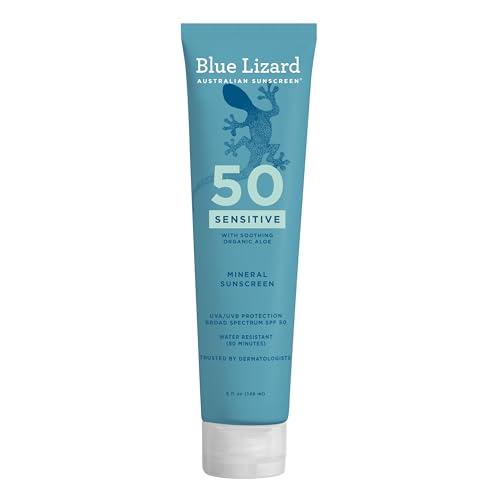
Product photo from Amazon.
Mineral-only at SPF 50+, fragrance-free and paraben-free, in a water-resistant base. It is the one to take on a hike rather than the one to wear under makeup.
Filters: Zinc oxide 10%, titanium dioxide 8%
What is in it
- Zinc oxide 10%
- Titanium dioxide 8%
- Tocopheryl acetate
Best for
High-SPF mineral for long days outside
Strengths
- Mineral only - zinc oxide 10% and titanium dioxide 8%
- SPF 50+ with water resistance
- No fragrance, no parabens, no chemical filters
- Large bottle - practical for face and body
Trade-offs
- Thick and noticeably casting
- Contains beeswax, so it is not vegan
Who should skip it: Not the pick for daily wear under makeup - it is too heavy. Use a fluid mineral for that.
#ad How we are funded - price as of November 18, 2026
Ingredient list read at INCIDecoder - Blue Lizard Sensitive Mineral Sunscreen SPF 50+.
What we screened out, and why
These are products you will find recommended elsewhere for this exact search. Each one is excluded here for a specific, checkable reason - not because it is a bad product, but because it does not clear the screen above.
Sunscreens with fragrance or parfum declared
Sunscreen is applied in more volume than any other leave-on product in a routine, reapplied through the day, and worn on skin that is simultaneously being warmed by the sun. That is the worst possible place to carry a fragrance mixture, and fragrance remains the leading cause of cosmetic contact allergy. One entry on the list and the bottle goes back.
Sprays and powders
Almost nobody applies enough from a spray to reach the SPF on the bottle, and the carrier is usually alcohol-based, which is its own problem on reactive skin. The AAD's own guidance on stick and spray sunscreens is to spray into your hands and rub it in rather than mist it at your face. A mineral powder is a touch-up over sunscreen, not sun protection.
Anything with denatured alcohol high on the list
Alcohol denat. is what makes a lot of Asian and European sunscreens feel weightless, and it is a real stinging trigger on a compromised barrier. It is not dangerous - it is just the wrong trade for this reader, and the finish it buys is available from other formulating choices.
Sunscreens sold on reef-safe or clean claims instead of a filter panel
Neither term has a regulatory definition in cosmetics, and both are routinely applied to products whose Active Ingredients panel we could not read without buying the bottle. The panel is the only part of a US sunscreen label with legally defined content, and it is the first thing we check.
SPF moisturizers and SPF makeup as the only sun protection
They are genuinely useful and they are the commonest way people end up under-protected, because nobody applies a quarter-teaspoon of face cream or a quarter-teaspoon of foundation. We cover the one sensible exception at best moisturizers with SPF for rosacea, and the honest answer is that it is a second layer, not a first one.
Sunscreens branded for sensitive skin that declare aromatic plant oils
Lavender, eucalyptus, citrus peel and tea tree oils all appear in sunscreens marketed at sensitive and 'natural' buyers. They are fragrance by chemistry and by function, a fragrance-free claim on the front does not stop a brand listing them on the back, and one of them sits on our own flagged list for exactly this reason.
High-SPF numbers with no broad-spectrum designation
SPF measures UVB protection only. A sunscreen can carry a big number and offer very little against UVA, which is the band most implicated in the long-term changes people are usually trying to prevent. Broad spectrum is a tested, regulated designation in the US and every pick here carries it.
The full list of what we flag, what each ingredient is and where the evidence is genuinely mixed lives on ingredients to avoid with rosacea.
Match the sunscreen to the actual obstacle
Sunscreen stings and you do not know which one to trust
La Roche-Posay Anthelios Mineral Zinc Oxide SPF 50. Mineral-only filters at a published titanium dioxide 6% and zinc oxide 5%, no added fragrance, and - crucially for this reader - no niacinamide, which rules out three of the four stinging suspects in one purchase. The fluid base is the part that makes it the default rather than just the safe answer: most high-load mineral sunscreens drag across skin, and this one spreads, which means you are more likely to apply a full dose. The trade is a cast you will see on medium and deep skin tones. Our full write-up is at La Roche-Posay Anthelios Mineral review.
You tolerate sunscreen fine - you just hate how it looks
EltaMD UV Clear SPF 46, with both caveats on the table. It is the best cosmetic finish on this page by a wide margin: weightless, no appreciable cast, and the sunscreen most dermatology offices hand to people who say they cannot wear sunscreen. It is also a hybrid - zinc oxide 9% with octinoxate 7.5% - so if mineral-only is the point for you, it is the wrong bottle. And it contains niacinamide, which is the reason a minority of rosacea readers find it flushes them. Neither of those facts makes it a bad sunscreen; both get left out of most recommendations. The detail is at our EltaMD UV Clear review.
You want mineral-only without the EltaMD price
CeraVe Hydrating Mineral Sunscreen Face Lotion SPF 50. Titanium dioxide 9% and zinc oxide 7%, no chemical absorbers, with ceramides NP, AP and EOP plus sodium hyaluronate in the base - so it moisturizes while it protects, which suits dry sensitive skin better than a matte fluid does. It is sold in every US pharmacy for a fraction of the cost of the clinic brands. The one thing to check is niacinamide, which CeraVe lists among the inactive ingredients. More drugstore options are at best drugstore sunscreens for sensitive skin.
Niacinamide flushes you and you still want a good finish
EltaMD UV Physical SPF 41. Mineral filters only, no niacinamide, and an iron oxide tint that cancels most of the white cast - which is the combination almost nothing else in this category offers. Iron oxides also add some protection against visible light, which matters for anyone whose redness or pigmentation is provoked by daylight rather than by UV alone. The limits are honest ones: it comes in a single tint, and it is thick enough that it needs warming between the fingers. The niacinamide-free shortlist in full is at best sunscreens for rosacea without niacinamide.
Your routine is two steps and you want it to stay that way
Vanicream Facial Moisturizer SPF 30. Zinc oxide at 19.5% - the highest single-filter load here - with five ceramides and squalane in the base, which makes it a moisturizer and a sunscreen in one step rather than an SPF with a moisturizing claim bolted on. For anyone who has been told to strip their routine back during a flare, collapsing two products into one genuinely helps. The honest trades are SPF 30 rather than 50, so reapplication matters more, and a heavy cast from that much zinc. Where SPF 30 is and is not enough is worked through at SPF 30 vs SPF 50 for sensitive skin.
You are going to be outside for hours
Blue Lizard Sensitive SPF 50+. Mineral-only at zinc oxide 10% and titanium dioxide 8%, fragrance-free, paraben-free, in a water-resistant base and a bottle big enough to do a face, a neck and two arms without rationing. It is the wrong sunscreen to wear under makeup - too thick, too casting - and the right one for a hike, a garden or a day on the water. It contains beeswax, so it is not vegan.
Your skin flushes rather than merely reacts
Then the screen tightens. Heat and sun exposure are two of the most-reported flare triggers in the National Rosacea Society's own patient surveys, which makes sunscreen more important for this reader, not less - and it makes niacinamide and the thermal load of a thick mineral film real considerations rather than footnotes. That version of this page is at best mineral sunscreens for rosacea, and whether sunscreen actually helps the condition rather than just the damage is answered at does sunscreen help rosacea.
The label checks that do most of the work
- Read the Active Ingredients panel first, not the front of the bottle. In the US this panel is legally defined and lists every filter with its percentage. 'Mineral-based', 'mostly mineral' and 'with zinc' are marketing phrases that survive the presence of octinoxate.
- Then scan the inactive list for fragrance, parfum or aroma. One word, and you are done. This check alone removes most of the aisle.
- Then scan for Latin plant names ending in oil. Lavandula angustifolia, citrus aurantium, eucalyptus globulus, melaleuca alternifolia. A fragrance-free claim does not stop a brand listing these.
- Check where alcohol denat. sits. High on the list means a thin, fast-drying finish and a likely sting on a compromised barrier.
- Check for niacinamide if you flush. It is in more sunscreens in this category than people expect, including two of the six here, and we name it on every card rather than burying it.
- Confirm the words broad spectrum. SPF is a UVB number. Broad spectrum is a separate, tested designation and it is the one that covers UVA.
None of that requires any expertise - it requires the back of the bottle, which is why we link a published list on every card instead of asking you to take our word for it. The method for reading one end to end is at how to read a skincare ingredient label.
Applying it so the number on the bottle means something
- 1Use roughly a quarter-teaspoon on the face alone. This is the dose the SPF was tested at. Half the dose does not give you half the SPF - the relationship is worse than linear, and under-application is the single commonest reason a good sunscreen underperforms.
- 2Put it on last, and give it a minute. Over moisturizer, under makeup. A thin lotion underneath rather than a petrolatum cream is what prevents the pilling that makes people give up on mineral formulas.
- 3Reapply every two hours outdoors, and after swimming or sweating. This is the AAD's standing advice and it applies to mineral filters as much as organic ones - they rub and sweat off the same way.
- 4Do not forget the places that actually burn. Ears, the back of the neck, the hairline, the eyelids and the tops of the hands. Most people's sun damage is concentrated exactly where their sunscreen habit stops.
- 5Pair it with the things sunscreen cannot do alone. Shade, a brimmed hat and the middle of the day are free and they outperform any reapplication schedule.
What we did not consider
Tinted formulas as a category, beyond the one tinted mineral pick above. Tint solves the cast problem and it introduces a shade-matching problem, and it deserves its own ranking rather than a footnote - that is at best tinted sunscreens for rosacea.
Sticks, which we rank separately because they are a different application problem: easy to under-apply, excellent for reapplying over makeup and around the eyes. They are at best sunscreen sticks for sensitive skin.
And body sunscreen as a distinct purchase. Several picks here are big enough to use on a body, and nothing about a face formula is wrong on an arm - it is simply expensive. Buy the face formula for your face and a cheaper fragrance-free mineral lotion for everything else.
How we chose
We read the published Active Ingredients panel and the full inactive list for every sunscreen considered, excluded anything carrying a flagged ingredient before looking at anything else, and then ranked what remained on how few variables it leaves, whether the filter load matches the SPF claim, and whether the finish is one a person will tolerate daily. We have no testing lab and we make no first-hand-use claim anywhere on this site - what we do is read the label and show our working, which is set out in full at how we choose.
Questions people ask
What is the best sunscreen for sensitive skin?
La Roche-Posay Anthelios Mineral Zinc Oxide SPF 50 for most people: mineral-only filters at a published titanium dioxide 6% and zinc oxide 5%, no added fragrance and no niacinamide, in a fluid that actually spreads. If your skin tolerates sunscreen and the obstacle is the cast rather than the sting, EltaMD UV Clear SPF 46 has the better finish - but it is a hybrid with octinoxate and it contains niacinamide.
Is mineral sunscreen better for sensitive skin?
As a first bet, yes - zinc oxide and titanium dioxide have essentially no sensitization record, which removes the filter from your list of suspects for very little money. But the gap is smaller than it is usually made to sound, and a hybrid you wear every day beats a mineral one you abandon after a week because of the cast.
Why does sunscreen sting my face?
In rough order of likelihood: fragrance, denatured alcohol, niacinamide if you are a flusher, and only then the filter itself. There is a fifth cause people miss - the layer underneath. An acid or retinoid applied an hour earlier, or a barrier that is currently compromised, will make a perfectly bland sunscreen feel like it is burning.
Is SPF 30 enough for sensitive skin?
SPF 30 applied at the full dose beats SPF 50 applied thinly, and that is not a close call. Thirty is the floor both the AAD and the FDA point to for daily use. If you are outdoors for hours, step up to 50 and reapply on schedule rather than relying on the number.
Do mineral sunscreens have to leave a white cast?
Untinted ones do, at the filter loads needed for SPF 50 - that is physics rather than formulating laziness. The two ways round it are an iron oxide tint, which cancels the cast and limits you to the shades the brand makes, or a hybrid formula with less mineral in it. The no-cast options are ranked at best sunscreens for sensitive skin with no white cast.
Does fragrance-free sunscreen actually exist?
Yes, and all six picks here are fragrance-free on their published lists. The caution is that fragrance-free addresses added perfume only - it does not stop a brand declaring lavender or eucalyptus oil under a botanical name on the same label. The distinction is worked through at fragrance-free vs unscented.
Can I just use a moisturizer with SPF instead?
As your only sun protection, no - not because the SPF is fake, but because nobody applies a quarter-teaspoon of face cream, and under-application costs you more protection than the label suggests. As a second layer on top of sunscreen, or on a day indoors, it is a reasonable thing to own. The trade-offs are at best moisturizers with SPF for rosacea.
Is sensitive skin the same thing as rosacea here?
No, and the screen differs. Rosacea involves flushing and a vascular component, so heat and niacinamide matter in a way they do not for ordinary sensitivity - the National Rosacea Society's patient surveys put sun exposure and heat among the most-reported triggers. The rosacea version of this shortlist is at best mineral sunscreens for rosacea, and the two conditions are compared at sensitive skin vs rosacea.