Moisturizers & Barrier Repair
La Roche-Posay Cicaplast Baume B5 review
A repair layer for the worst two days, not the cream you wear every morning.
By Michael W. · Last updated
The short answer
The best over-the-counter rescue layer for raw, stinging, over-treated patches of skin, and the wrong product to use as a daily moisturizer. Twenty-two ingredients, no fragrance, no essential oils, no alcohol, built on hydrogenated polyisobutene, dimethicone and shea butter with panthenol and madecassoside on top. It is thick, slightly tacky, leaves a faint white cast, and has no ceramides in it at all.
Some links on this page are affiliate links. If you buy through one, we may earn a commission at no extra cost to you - it is what funds the site. It does not change what gets recommended or in what order. Full disclosure.
Cicaplast Baume B5 is the product people reach for when their face has gone past dry and into sore. It gets recommended for post-procedure skin, for retinoid peeling, for the raw patch beside the nose two days into a flare, for cracked hands and chapped lips and babies' cheeks - which is an unusually wide brief for a twenty-two-ingredient balm, and most of it is deserved.
What it is not is a moisturizer, in the sense of the thing you put on your whole face twice a day. That distinction is the whole review. Used as a repair layer it is excellent and cheap. Used as a daily cream it is heavy, slightly tacky, visibly white on application, and missing the one ingredient class a damaged barrier most needs.
What is actually in it
Twenty-two ingredients, with the published list linked at the bottom of this page. The seven that matter:
- Hydrogenated polyisobutene, second on the list. A synthetic occlusive - the thing doing most of the sealing. It behaves like a light mineral oil without the greasiness, and it is one of the reasons the balm sits on skin rather than sinking in.
- Dimethicone, third. A silicone, and the reason the texture spreads at all over a layer that thick. It also gives the balm its characteristic slip. Where we stand on silicones in a rosacea routine is at is dimethicone good for rosacea.
- Glycerin and shea butter, fourth and fifth. The humectant and the emollient. Shea is the single ingredient most likely to be a problem for anyone with a tree-nut history, and the full picture on it is at is shea butter good for rosacea.
- Panthenol - pro-vitamin B5, the ingredient the product is named after. It converts to pantothenic acid in skin and has the best-established record of anything here for comfort on irritated, healing skin. The published list does not state a percentage, so neither will we.
- Madecassoside, a purified fraction of centella asiatica rather than a whole-plant extract. That matters: an isolated triterpene carries none of the variability of a botanical extract. What the evidence actually supports is at does centella asiatica help rosacea.
- Zinc, manganese and copper gluconate, listed separately and together making up the trace-mineral complex the range is built around.
- Titanium dioxide, declared as a colorant (CI 77891). This is why the balm is opaque white and why it leaves a faint cast on application. It is not a sunscreen filter at this level and the product carries no SPF.
What is not in it is as important. No fragrance. No masking fragrance. No essential oils. No denatured alcohol. For a product this widely recommended for compromised skin, that is the bar it has to clear and it clears it.
What it does well
Occlusion plus comfort, on a small area, for a short period. If you have a patch of skin that is raw - over-exfoliated, wind-burned, peeling from an active you introduced too fast, cracked at the corner of the mouth - a thick fragrance-free film with panthenol under it is the most reliable intervention available over the counter. The balm stays where you put it, which is more than most creams manage, and it does not need reapplying every two hours.
It is also genuinely well suited to the nose and the nasolabial folds, which are the two places rosacea-prone skin most often goes raw and the two places a thin lotion runs off. The targeted version of that problem is covered at best creams for rosacea on the nose.
And it is cheap for what it is. A small tube used in spot application lasts a long time, which makes it an easy thing to keep in a drawer for the fortnight a year you actually need it.
What it does not do
- No ceramides, no cholesterol, no fatty acids. It seals a barrier rather than rebuilding one. If your skin is chronically compromised rather than acutely sore, a ceramide cream does more over a month - see best barrier repair creams.
- It is not a redness treatment. Nothing in the formula targets vascular redness. A calmer, better-sealed barrier is less easily provoked, and that is the whole mechanism. The products built specifically for redness are at best redness relief creams.
- It does not layer under sunscreen or makeup. The silicone-and-polyisobutene film plus mineral SPF is a reliable recipe for pilling, and the titanium dioxide cast shows through most foundations. This is a night product and a spot product in practice.
- It is not sized or priced for whole-face daily use. The tube is small on purpose. Using it as your everyday moisturizer is both expensive and heavier than most faces want.
- It is not elegant. It is thick, it is slightly tacky for the first few minutes, and it leaves a sheen. Nothing about the formula is trying to solve that.
The chlorhexidine question
Cicaplast Baume B5 contains chlorhexidine digluconate, an antiseptic that also functions as a preservative here. It is the one ingredient on the list worth flagging specifically, for two reasons.
The first is that chlorhexidine is a recognized contact sensitizer. The number of people affected is small, but it is not zero, and it appears on dermatology patch-test panels for exactly that reason. If you have ever reacted to a medicated wipe, a surgical skin prep or an antiseptic mouthwash, this is a plausible culprit and worth mentioning to a clinician before you use the balm on broken skin.
The second is more mundane: it means the balm is not simply a bland occlusive. If you are mid-elimination and trying to work out what your face is objecting to, a twenty-two-ingredient balm with an antiseptic in it is the wrong instrument. For that job you want the shortest list you can find, which is why our troubleshooting pick is an eleven-ingredient petrolatum cream and not this.
How it compares
| Cicaplast Baume B5 | Vanicream Moisturizing Cream | CeraVe Moisturizing Cream | |
|---|---|---|---|
| Ingredients | Twenty-two | Eleven | Around twenty-four |
| Occlusive | Hydrogenated polyisobutene, dimethicone, shea | Petrolatum | Petrolatum |
| Barrier lipids | None | None | Ceramides NP, AP, EOP plus cholesterol |
| Soothing actives | Panthenol, madecassoside, trace minerals | None | None |
| Preservative | Sodium benzoate, chlorhexidine digluconate | Simple system, no antiseptic | Phenoxyethanol |
| Leaves a cast | Yes - titanium dioxide | Slight sheen, no cast | No |
| Best used as | A short-term repair layer on small areas | An everyday cream when you are troubleshooting | An everyday cream for barrier rebuilding |
The honest summary of that table is that these three products are not competing. Cicaplast is the thing you add for two days; Vanicream is the thing you use when you need to remove variables; CeraVe is the thing you use for months to rebuild. If you are only buying one cream, it should not be this one. The ranking that answers that question is at best moisturizers for sensitive skin.
The picks, in order
1. A rescue balm for the worst two days of a flare
La Roche-Posay Cicaplast Baume B5
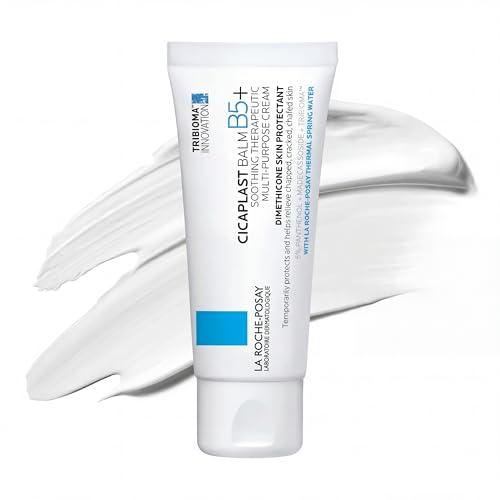
Product photo from Amazon.
A thick fragrance-free balm with panthenol, madecassoside and shea butter. This is a short-term repair layer for raw, stinging patches, not a daily moisturizer for the whole face.
What is in it
- Panthenol
- Madecassoside
- Shea butter
- Glycerin
Best for
A rescue balm for the worst two days of a flare
Strengths
- Panthenol and madecassoside - both well studied for irritated skin
- No added fragrance
- Thick enough to act as an overnight occlusive layer
- A small tube lasts a long time in spot use
Trade-offs
- Heavy and slightly tacky - not a daily all-over cream
- Contains chlorhexidine digluconate, which a small number of people react to
Who should skip it: If you want one cream for everyday use, this is not it - it is a targeted repair layer.
#ad How we are funded - price as of November 18, 2026
Ingredient list read at INCIDecoder - La Roche-Posay Cicaplast Baume B5.
How to use it without wasting it
- 1Spot application, not all over. A rice-grain amount on the specific patch, pressed rather than rubbed.
- 2At night, over your moisturizer. It is the last layer, not a replacement for the cream underneath. Putting a sealing film over a hydrating cream is the whole point.
- 3Two to five nights, then stop. This is a repair product. If a patch of skin still needs it after a week, the problem is upstream - something in your routine, or something that needs a clinician.
- 4Not in the morning if you wear SPF. It will pill. Use your usual light lotion and keep the balm for the night slot.
- 5Keep it for the flare. The routine for the days when everything optional stops is at how to calm a rosacea flare-up.
Who should skip it
Anyone with a tree-nut sensitivity who reacts to shea butter, anyone with a chlorhexidine history, and anyone currently running an elimination period who needs the shortest ingredient list they can get. Also anyone shopping for one cream to do everything - that is a different product, and this balm will disappoint you in that role rather than fail at it.
If you want the La Roche-Posay cream that does work as an everyday moisturizer, it is the Toleriane Double Repair, reviewed separately at La Roche-Posay Toleriane Double Repair review. Same brand, entirely different job: light, fast-absorbing, ceramide NP, and it layers under sunscreen without pilling.
The verdict
Buy it, keep it in the cupboard, and use it for a few nights at a time. On that basis it is one of the best-value products in this category: fragrance-free, essential-oil-free, alcohol-free, with two of the better-evidenced soothing ingredients in skincare and an occlusive film that stays put. Judged as the daily moisturizer the marketing sometimes implies, it is the wrong shape - no barrier lipids, a white cast, and a tackiness that nothing in the routine after it will forgive. Both things are true, and which one you get depends entirely on how you use it.
We have no testing lab and we make no first-hand-use claim anywhere on this site. Everything above is read off the published ingredient list and set against the published evidence for the actives in it; the method is at how we choose.
Questions people ask
Is Cicaplast Baume B5 good for rosacea?
As a short-term repair layer on raw or stinging patches, yes - it is fragrance-free, essential-oil-free and alcohol-free, with panthenol and madecassoside. As a daily all-over moisturizer for rosacea, no: it has no ceramides, it pills under sunscreen, and it leaves a faint white cast from the titanium dioxide colorant.
Does Cicaplast Baume B5 contain fragrance?
No. There is no fragrance, masking fragrance or essential oil on its published ingredient list, and no denatured alcohol either. The ingredient worth noting instead is chlorhexidine digluconate, an antiseptic that a small number of people react to.
Can I use Cicaplast Baume B5 every day?
You can, but most people should not use it as their whole-face daily cream. It is thick, slightly tacky, and has no barrier lipids in it. The pattern that works is a ceramide cream daily and the balm on top of it for a few nights when a patch of skin needs rescuing.
Why does Cicaplast Baume B5 look white on my skin?
Titanium dioxide, declared as the colorant CI 77891, which is what makes the balm opaque. It is not a sunscreen filter at this level and the product carries no SPF, so it does not replace your sunscreen. On deeper skin tones the cast is more noticeable and worth applying sparingly at night rather than in the morning.
Cicaplast Baume B5 or Vanicream?
Different jobs. Cicaplast for a few nights on a sore patch, because panthenol and madecassoside are genuinely useful there. Vanicream for everyday use and especially while you are troubleshooting, because eleven ingredients is the instrument you want then - the full review is at Vanicream Moisturizing Cream review.
Is Cicaplast Baume B5 the same as Cicaplast Baume B5+?
La Roche-Posay has sold more than one version of the balm, and the ingredient list we reviewed is the one published for Cicaplast Baume B5 at the URL in our sources. Formulas and names change by market and over time, so check the list on the tube you are holding - the published list on the brand's own site always wins over ours.
Can I use it on my lips, hands or on a baby?
The Amazon listing is sold for body and hands and describes the balm as baby safe, and La Roche-Posay markets it as a multi-purpose balm. We have no basis to add to or subtract from that beyond the ingredient list, which is fragrance-free and essential-oil-free. For broken skin or anything on an infant, ask a clinician rather than a review page.
Does it help with retinol peeling?
It is one of the most sensible things to use for it: an occlusive film with panthenol under it, applied at night over your moisturizer, on the areas that are peeling. It does not make the retinol gentler - that is a dosing problem, covered at how to start retinol with sensitive skin.