Routines & Flare Care
How often should you moisturize with rosacea?
Twice a day. The harder question is when in the minute after you rinse.
By Michael W. · Last updated
The short answer
Twice a day for almost everyone with rosacea: once in the morning under sunscreen and once at night, each within a minute of rinsing. The timing matters more than the frequency, because a moisturizer applied to damp skin holds water that an identical application on dry skin does not. During a flare, three or four thin applications beat one thick one. Vanicream Moisturizing Skin Cream is the night pick, La Roche-Posay Toleriane Double Repair is the one that layers under mineral SPF in the morning, and CeraVe Moisturizing Cream does both at the lowest cost.
Some links on this page are affiliate links. If you buy through one, we may earn a commission at no extra cost to you - it is what funds the site. It does not change what gets recommended or in what order. Full disclosure.
Rosacea is, among other things, a barrier problem. Skin affected by it loses water faster than unaffected skin, which is why it feels tight and stings at products that other people find unremarkable. Moisturizing is not a comfort measure layered on top of the real treatment - it is a large part of the treatment, and the frequency question has a short answer and a more useful longer one.
The short answer is twice a day, every day, flare or no flare. The longer answer is that most people get less from their moisturizer than they should because of when they apply it rather than how often. Skin that has just been rinsed is holding water at the surface, and a cream applied into that window traps it. The same cream applied ten minutes later, to skin that has already dried, is working with much less.
The schedule, including the exceptions
| Situation | How often | Notes |
|---|---|---|
| Normal week, no flare | Twice daily | Morning under sunscreen, night after cleansing |
| Active flare | Three to four thin applications | Thin and frequent, not thick and once |
| Starting azelaic acid or any active | Twice daily minimum | Dryness accumulates across the week, not the evening |
| Oily or combination skin | Twice daily, lighter texture | Oil is not water; skipping it raises oil output |
| Winter, indoor heating | Twice, plus an occlusive at night | Low humidity is the variable, not the season |
| After exercise | Once more, after rinsing | Salt and heat are both triggers; rinse and re-moisturize |
| Overnight occlusive layer | Optional, 2-3 nights a week | Petrolatum over your cream on the driest areas |
The row people argue with is the fourth one. Oily skin feels like it does not need a moisturizer, and on rosacea-prone skin it almost always does - oil and water are separate problems, and dehydrated skin compensates by producing more sebum, not less. The fix is a lighter texture rather than a skipped step.
What over-moisturizing actually looks like
It is a genuine thing and it is rarer than the internet suggests. The real version is not twice-daily use - it is heavy occlusive layers applied repeatedly to skin that is not dry, which can soften the surface excessively, trap sweat under the layer and, in the pores on and around the nose, contribute to congestion. The signs are a face that feels slick rather than comfortable, small bumps appearing in the areas you apply most, and makeup that will not sit.
- Twice daily with an appropriate texture is not over-moisturizing. This is the baseline, not an excess.
- Four thin applications during a flare is not over-moisturizing. Thin is the operative word.
- A petrolatum-led cream all over an oily face twice a day probably is too much. Match the texture to the skin, not to the fear of dryness.
- Reapplying a rich cream over makeup is a different problem. It pills, and the layer underneath does not benefit.
- If it is slick rather than comfortable, use less of the same product. Changing products is the expensive version of a free fix.
The format you choose matters as much as the frequency, and it is a bigger lever than most people realise - a lotion, a cream and an ointment of similar quality behave very differently on the same face at the same frequency. The comparison is at cream vs lotion vs ointment for sensitive skin.
The screen
Every product on this page had to clear all of the following before it was considered on its merits. This is the exclusion step, and it runs before any recommendation.
- No added fragrance or parfum anywhere in the ingredient list.
- No essential oils, including ones declared under a botanical name.
- No denatured alcohol, witch hazel, menthol, camphor or peppermint.
- No physical scrub particles.
- Sold in the US right now, from a brand that publishes its full ingredient list.
- Every remaining flagged ingredient is named on the product card rather than quietly left out.
Ingredient lists last checked 2026-09-29. Formulas change - if you spot a discrepancy, the published list on the brand's own site wins and we want to know.
Quick picks
Every product here cleared the screen. Tap a row for the full write-up.
| # | Product | Best for | Fragrance | Price |
|---|---|---|---|---|
| 1 | 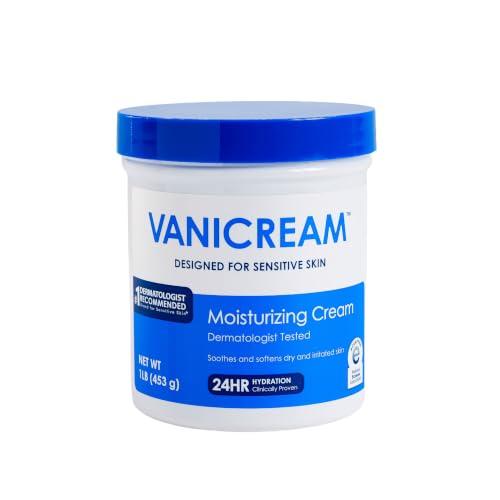 Vanicream Moisturizing Skin Cream Eleven ingredients, petrolatum second on the list, and no fragrance, essential oils or botanicals anywhere. | A barrier rebuild with nothing else in the way | Free | |
| 2 | 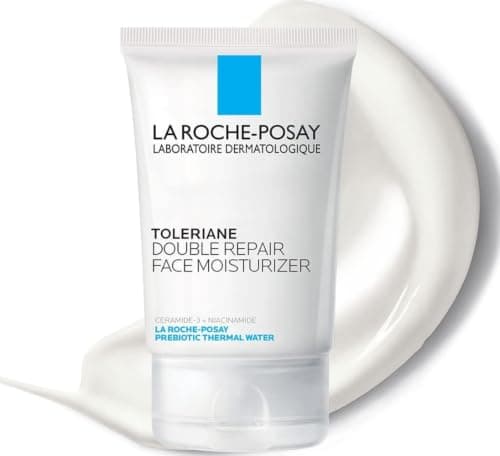 La Roche-Posay Toleriane Double Repair Face Moisturizer Light, fast-absorbing, fragrance-free, with ceramide NP and glycerin doing the barrier work. | Daily moisturizer that disappears under sunscreen | Free | |
| 3 | 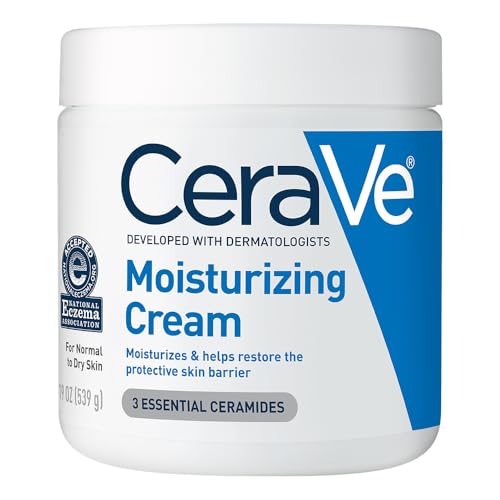 CeraVe Moisturizing Cream Three ceramides plus cholesterol and petrolatum, no fragrance, in a tub big enough to use on your body too. | Barrier repair on a budget | Free |
#ad - Amazon links are affiliate links. Prices come from the Amazon API, are refreshed daily, and disappear rather than go stale - the button shows the current number or it asks you to check.
The picks, in order
1. A barrier rebuild with nothing else in the way
Vanicream Moisturizing Skin Cream
Product photo from Amazon.
Eleven ingredients, petrolatum second on the list, and no fragrance, essential oils or botanicals anywhere. It is an occlusive that seals water in. It is not elegant and it is not trying to be.
What is in it
- Petrolatum
- Sorbitol
- Glyceryl Stearate
- Simethicone
Best for
A barrier rebuild with nothing else in the way
Strengths
- Eleven ingredients total
- Petrolatum-led - the most reliable occlusive there is
- No fragrance, essential oils or botanical extracts
- Sold in a large tub; cost per ounce is very low
Trade-offs
- Heavy and slightly waxy - it sits on skin rather than sinking in
- No soothing or barrier actives beyond the occlusion itself
Who should skip it: If you wear makeup daily or your skin is oily, this will feel like too much - use it at night only, or pick a lighter cream.
#ad How we are funded - price as of November 18, 2026
Ingredient list read at INCIDecoder - Vanicream Moisturizing Skin Cream.
2. Daily moisturizer that disappears under sunscreen
La Roche-Posay Toleriane Double Repair Face Moisturizer
Product photo from Amazon.
Light, fast-absorbing, fragrance-free, with ceramide NP and glycerin doing the barrier work. Niacinamide sits fifth on the list, which is the only reason it is not our first pick for everyone.
What is in it
- Niacinamide
- Ceramide NP
- Glycerin
- Prebiotic thermal water
Best for
Daily moisturizer that disappears under sunscreen
Strengths
- Absorbs in seconds - layers cleanly under mineral SPF
- Ceramide NP and glycerin for barrier and water
- No added fragrance
- Works year-round for most skin types
Trade-offs
- Niacinamide is fifth on the ingredient list - a flushing trigger for some
- Not rich enough on its own for very dry skin in winter
Who should skip it: Skip if niacinamide reliably flushes you. Also skip as a standalone if your skin is very dry - layer it over an occlusive.
#ad How we are funded - price as of November 18, 2026
Ingredient list read at INCIDecoder - La Roche-Posay Toleriane Double Repair Face Moisturizer.
3. Barrier repair on a budget
CeraVe Moisturizing Cream
Product photo from Amazon.
Three ceramides plus cholesterol and petrolatum, no fragrance, in a tub big enough to use on your body too. This is the cream most dermatology offices hand out, and the formula earns it.
What is in it
- Ceramide NP, AP and EOP
- Petrolatum
- Sodium Hyaluronate
- Cholesterol
Best for
Barrier repair on a budget
Strengths
- Ceramides NP, AP and EOP with cholesterol - a complete lipid set
- Petrolatum for occlusion plus hyaluronic acid for water
- No added fragrance
- Very low cost per ounce in the large tub
Trade-offs
- Thick - it needs warming between your palms in winter
- The tub invites fingers into the product; the pump version is more hygienic
Who should skip it: Oily or acne-prone skin may find the richness too much for daytime; use the lotion version instead.
#ad How we are funded - price as of November 18, 2026
Ingredient list read at INCIDecoder - CeraVe Moisturizing Cream.
The two slots, and what goes in each
- 1Morning, under mineral sunscreen. A cream that absorbs in under a minute, because a mineral SPF applied over a wet film will pill. La Roche-Posay Toleriane Double Repair is the pick, with niacinamide fifth on the list as the thing to check.
- 2Night, after one gentle cleanse. Something heavier, since nothing goes over it. Vanicream Moisturizing Skin Cream - eleven ingredients, petrolatum second, no botanicals at all.
- 3One product for both slots, at the lowest cost. CeraVe Moisturizing Cream. Three ceramides plus cholesterol and petrolatum, in a tub large enough for face and body. Warm it between your palms in winter.
- 4During a flare, the same product more often. Do not introduce a new cream mid-flare. Thin layers of something your skin already tolerates, three or four times a day.
That last instruction is the one worth remembering because it goes against instinct. A flare is the moment people buy something new, and it is the worst moment to do it - the skin is at its most permeable, your judgement of what helped is at its least reliable, and a reaction to the new product is indistinguishable from the flare continuing. The flare protocol, including what to actually do for the first forty-eight hours, is at how to calm a rosacea flare up.
Six habits that matter more than frequency
- Apply to damp skin, within a minute. The highest-value habit on this page.
- Pat dry, never rub. Friction is the most consistent self-inflicted irritant in rosacea care.
- Lukewarm water, not hot. Heat is a flushing trigger in its own right, and hot water strips more lipids.
- One cleanse a day, in the evening. Water alone is usually enough in the morning - the reasoning is at how to cleanse rosacea-prone skin.
- Mineral sunscreen every morning over the moisturizer. UV is the most commonly reported trigger, and this is the step that changes things over months.
- Keep the product count low while you are learning your triggers. Three products let you identify a cause; seven do not.
If you are building this from scratch rather than adjusting an existing routine, the order and the product count are set out at beginner rosacea routine, and the full ranked moisturizer list - including the lighter and richer options for the two slots above - is at best moisturizers for rosacea.
How we chose
Published ingredient lists read on each brand's own site and on INCIDecoder, with the source linked on every pick, screened for added fragrance, masking fragrance, essential oils and the flagged ingredients on our avoid list. Frequency and technique guidance follows the National Rosacea Society's published skin-care advice on gentle cleansing and prompt moisturizing; where that advice is silent we say so rather than inventing a rule. Prices are pulled from the Amazon API, refreshed daily and stamped with the date they were read. Method at how we choose.
Questions people ask
How often should you moisturize with rosacea?
Twice a day - morning under sunscreen and night after cleansing - each within about a minute of rinsing, while the skin is still faintly damp. During a flare, three or four thin applications beat one thick one.
Can you over-moisturize rosacea?
It is possible but uncommon. The real version is heavy occlusive layers applied repeatedly to skin that is not dry, which can leave the surface slick and contribute to congestion around the nose. Twice-daily use with an appropriate texture is the baseline, not an excess.
Should I moisturize if my skin is oily and I have rosacea?
Yes. Oil and water are separate problems, and dehydrated skin raises its sebum output rather than lowering it. Use a lighter gel or lotion texture rather than skipping the step.
Is it better to moisturize on damp or dry skin?
Damp, clearly. A cream applied within a minute of rinsing traps the water still sitting at the surface. The same cream ten minutes later has much less to work with - which is why timing matters more than brand.
Should I moisturize more often during a flare?
Yes, and thinly. Three or four light applications of a product your skin already tolerates. Do not introduce a new cream mid-flare: a reaction to it is indistinguishable from the flare continuing.